St. Patrick's Day
It is St. Patrick's Day and the sun is shining! This week I decided to learn more about St. Patrick by reading Newport White's St.. Patrick: His Writings and Life, which was published in 1920. It was a fascinating read! You can get a free pdf copy or copy for your Kindle here. Being old fashioned, I bought an ex-library copy from the University of Glasgow!
I hope you enjoy St. Patrick's Day. Below is one of my favourite clips from The Muppet Show - it is particularly apt for St. Patrick's Day!
Dividend Policy
This week my Corporate Finance class were looking at corporate dividend policy. Two recent news items highlight the centrality and importance of the dividend decision.
First, last week’s Economist argued that Apple should return to investors the $100b of cash it has on its balance sheet (click here). One theory is that Apple seems to fear that the act of returning cash to shareholders may signal to the market that its best days are behind it. Another theory is that the near-bankruptcy experience of Apple in the 1990s meant that Steve Jobs had a strong preference for hoarding cash. This may be an example of where managerial traits and experiences affect corporate policy.
Second, a report by a Research Fellow at the American Enterprise Institute suggests that the Obama administration plans to increase dividend taxes from 15% to 45%, the highest in 27 years. A study by Chetty and Saez shows that the Bush dividend tax cut of 2003 resulted in more firms paying dividends and dividend payers paying higher dividends. For some observers, this greatly improved corporate governance as managers had less free cash flow which could be diverted towards pet projects or perquisites.
The Kay Review of UK Equity Markets
I have recently finished reading the interim report of the Kay Review. The terms of reference for the review are: "to examine the mechanisms of corporate control and accountability provide by UK equity markets and their impact on the long term competitive performance of UK businesses". All finance students should read this interim report as well as anyone interested in equity markets - click here.
Here are some of my highlights:
1. There has been a decline in collective action by institutional investors.
2. The mode of appointing non-executives (by a board committee with substantial input from the Chairman) raises questions about their independence.
3. Some non-executive directors may hold too many non-executive roles to perform effectively.
4. The increase in nominee holdings due to the introduction of electronic trading and settlement means that the majority of holdings of UK equities are nominee holdings, which means that beneficial shareholders are not on share register, do not receive information from company, and have no voting rights.
5. Personal shareholders have become disenfranchised.
6. The regulatory framework now favours liquidity over long-term ownership.
7. The primary market (IPOs) in the UK is not working well at the minute. There has been a substantial fall in listings on the main exchange.
8. Many mining and commodity companies, whose operations are mostly outside the UK, are now listed on the London market. Many of these companies have lower corporate governance standards as well as a limited free float of shares.
9. There is a lot of vehement criticism of high frequency trading by respondents to the Review.
10. Insider trading rules appear to inhibit asset management firms and institutional shareholders from engaging directly with managers of companies.
11. Institutional investors favour exit over voice.
12. The UK is an outlier amongst major economies in that share ownership is highly dispersed. Family ownership is not very common in the UK, whereas it is common amongst medium-sized US corporations.
Overall, these potential deficiencies may undermine the UK equity market, which would be detrimental for companies requiring equity finance and savers looking for a decent return on their investment. It will be interesting to see what recommendations the final report makes.
Mafianomics II
It seems that economists at Queen's have a lot to say about the origins of the Mafia. After Chris Colvin's review was picked up by Monday's FT, I learned that Arcangelo Dimico and co-authors have just finished a working paper on the origins of the Mafia. Their paper is entitled "Origins of the Sicilian Mafia: The Market for Lemons" - you can access it here.
Mafianomics
A recent working paper investigating the historical and geographical origins of the Mafia has been reviewed by Chris Colvin at the NEP-HIS Blog. His review was picked up by the Financial Times (click here). You can read Chris's Blog post here and access Buonanno et al's paper here.
Paper abstract:
This research attempts to explain the large differences in the early diffusion of the mafia across different areas of Sicily. We advance the hypothesis that, after the demise of Sicilian feudalism, the lack of publicly provided property-right protection from widespread banditry favored the development of a florid market for private protection and the emergence of a cartel of protection providers: the mafia. This would especially be the case in those areas (prevalently concentrated in the Western part of the island) characterized by the production and commercialization of sulphur and citrus fruits, Sicily’s most valuable export goods whose international demand was soaring at the time. We test this hypothesis combining data on the early incidence of mafia across Sicilian municipalities and on the distribution of sulphur reserves, land suitability for the cultivation of citrus fruits, distance from the main commercial ports, and a variety of other geographical controls. Our empirical findings provide support for the proposed hypothesis documenting, in particular, a significant impact of sulphur extraction, terrain ruggedness, and distance from Palermo’s port on mafia’s early diffusion.
CEO Age and Mergers
Does the age of a CEO affect corporate performance and corporate policy? Are older CEOs less acquisitive? Does the wisdom of years make them better managers? Have their greater experiences of boom and bust made older CEOs more risk averse? Is there a last-period problem with older CEOs? Have older CEOs got the energy to manage complex organisations?
Two recent papers examine how CEO age affects acquisition behaviour. Soojin Yim in a recent working paper finds that older CEOs are less acquisitive - she finds that a firm with a CEO who is 20 years older is 30% less likely to announce an acquisition. Yim interprets this finding as evidence to support the agency problem. Jenter and Lewellen in their NBER working paper document the effect of CEO age on merger behaviour. Here is the abstract of their paper:
This paper explores the impact of target CEOs’ retirement preferences on the incidence, the pricing, and the outcomes of takeover bids. Mergers frequently force target CEOs to retire early, and CEOs’ private merger costs are the forgone benefits of staying employed until the planned retirement date. Using retirement age as an instrument for CEOs’ private merger costs, we find strong evidence that target CEO preferences affect merger patterns. The likelihood of receiving a takeover bid increases sharply when target CEOs reach age 65. The probability of a bid is close to 4% per year for target CEOs below age 65 but increases to 6% for the retirement-age group, a 50% increase in the odds of receiving a bid. This increase in takeover activity appears discretely at the age-65 threshold, with no gradual increase as CEOs approach retirement age. Moreover, observed takeover premiums and target announcement returns are significantly lower when target CEOs are older than 65, reinforcing the conclusion that retirement-age CEOs are more willing to accept takeover offers. These results suggest that the preferences of target CEOs have first-order effects on both bidder and target behavior.
Oil Prices and the Housing Crash
What caused the Great Crash of 2008? The proximate cause was the collapse of house prices. Why did house prices collapse? There is an interesting post over at Freakonomics which suggests that the collapse in US house prices was triggered by the large increase in gas (petrol) prices in 2006-7, which dramatically increased the cost of commuting from the suburbs. The full paper is available here. However, the increase in gas prices was only a trigger, and it cannot explain the extent of the fall in house prices in the USA, Ireland, UK, and other economies.
Golf and Capitalism
This week Northern Ireland's Rory McIlroy became the number one golfer in the world. This reminded me of Armen Alchian's 1977 editorial in the Wall Street Journal, where he posed the question why is golf solely found in capitalist societies? He argued that
You can read Alchian's entire WSJ oped piece here. Notably, a recent empirical study in the Atlantic Economic Journal provides support for Alchian's thesis."Golf's ethic, principles, rules and procedures of play are totally capitalistic. There are antithetical to socialism. Golf requires self-reliance, independence, responsibility, integrity and trust. No extenuation is granted misfortune, mistake or incompetence. No second chance. Like life, it is often unfair and unjust, with uninsurable risks. More than any other sport, golf exploits the whole capitalist spirit."
Diamond Districts
I have been in a lot of major cities in my lifetime, and several of them have a thriving diamond district. Click here to read an interesting take on why diamond shops in most major cities tend to locate close to each other. The basic argument is that it lowers search and information costs for diamond customers. I am not sure if this is totally correct. Another possible reason why diamond shops may locate close to one another is that by being close together, they lower their joint security costs. Given the density of diamond shops in one area, one would expect more cctv, police patrols etc.. Notably, all of the major diamond shops near Hatton Gardens in London are two minutes away from the nearest police station!
Higher Education Bubble: An Infographic
Some of the authors at Education News sent me a neat infographic after reading one of my previous posts on the higher education bubble. Click here to see it. The accumulation of debt by US students to pay for their education is such that the sum of total student debt exceeds the sum of total credit card debt in the US! My fear is that the UK will eventually head in the same direction, with ever-increasing tuition fees being paid for by an ever-increasing student debt.
Romer on the Great Depression
My Money and Banking class this week looked at the Great Depression. You can read a recent interview given by Christina Romer, former chair of Obama’s Council of Economic Advisers, where she reviews five books/articles on the Great Depression – click here. This interview gives a good overview regarding the causes and cures of the Great Depression.
One thing which emerges from Romer’s interview is that many economists have been drawing close parallels between the Great Depression and the ongoing Great Recession. These parallels have been used to justify the extreme policy interventions used by central banks and governments. As much as I like to see governments and economists drawing lessons from economic history, one has to wonder whether we have been hasty in drawing comparisons between the two episodes. Have our political leaders simply used the Great Depression (and our fears of a repeat) as a justification to bail out large financial institutions? Or has it been a stroke of genius / serendipity to have experts on the Great Depression, such as Bernanke and Romer, at the centre of policy-making?
Ireland and the European Stability Treaty
In the Dáil yesterday, Taoiseach Enda Kenny stated that a referendum would be held regarding Ireland's participation in the European Stability Treaty (click here for Irish Times coverage). This referendum adds to the uncertainty surrounding the euro, and a 'no' vote in the referendum would raise series doubts about Ireland's participation in the euro. The EU may now be tempted to buy off Irish voters to ensure a 'yes' vote in the referendum.
Raymond Crotty, an Irish economic historian, instigated a High Court action against the Irish government in 1987, which resulted in the ruling that all significant changes to EU treaties required an amendment to the Irish constitution. Amendments to the Irish constitution can only be made by holding a referendum. At least the Irish electorate, unlike most of their EU contemporaries, are getting a say on the European Stability Treaty!
Intelligence and Investment
Robert Shiller has an interesting piece in the NY Times on whether high-IQ investors build better portfolios than their low-IQ peers. Click here for the article.
Read More
US Monetary Policy
This is a fascinating 15-minute video, where George Selgin criticises the operation of U.S. monetary policy. In particular, he criticises the Fed for only engaging in open market operations with primary dealers (i.e., large stable (?) financial institutions) and only buying and selling government securities. He recommends that both these policies be ended and that the Fed stops lending directly to individual institutions i.e., that it closes its discount window.
Pricking Bubbles
Should central banks intervene to burst asset price bubbles? In this nine-minute video, Adam Posen of the MPC argues that central banks should not intervene to prick booms as not all booms are followed by a bust. In other words, central banks cannot identify ex ante if a boom is an asset price bubble.
University Economics
There is an interesting piece over at VOX (hat tip - Graham Brownlow) asking whether economics undergraduates are being well trained - click here. There are at least six things which stand out for me in this piece.
1. Economics degrees need some economic history - economic history asks the big questions that need to asked.
2. There is too much of a focus on mathematics rather than economic intuition.
3. There is an overemphasis on econometric theory at the expense of analysing real data.
4. Econ graduates know very little about institutions and workings of the actual economy. For example, they know very little about finance, banking, and the monetary system.
5. There needs to be more heterodoxy e.g., networks
6. Graduates have little in the way of well-developed communication and presentation skills.
I totally agree with these critiques, and I am proud to say that these criticisms cannot be levelled against the graduates that Queen's University Management School produces - particularly those on the BSc Finance (but I would say that!).
David Graeber on Menger
Owen Sims, a grad student at Queen’s, recently pointed me in the direction of David Graeber’s Debt: The First 5,000 Years (an interview with Graeber about his recent book is available below). Graeber is an anthropologist and anarchist. My interest in Graeber was piqued by the fact that he has a go at Austrian economists in general and Menger’s theory of the origin of money in particular.
I have yet to finish reading his book, but I agree with Graeber’s critique of Menger that barter is a myth. The historical and anthropological evidence on this is compelling. I also agree with his critique of Austrian economics – he sees it more as a religion or ideology. There is much to be learned from Austrian economics, but we must be careful that our analysis of economic phenomena does not descend into mere ideology.
Click here for an extensive post by Graeber on money, Menger, and Austrian economics.
Earning a 'Buck'
Why do Americans refer to their money as bucks? The European colonial settlers ran into problems whenever they attempted to trade with the Native Americans as the latter were unwilling to accept bank notes and coins. Tobacco or wampum was sometimes used as a medium of exchange, but gradually deerskins or buckskins became the common medium of exchange (or money). Hence, to this day, Americans refer to their money as ‘bucks’!
National Debt
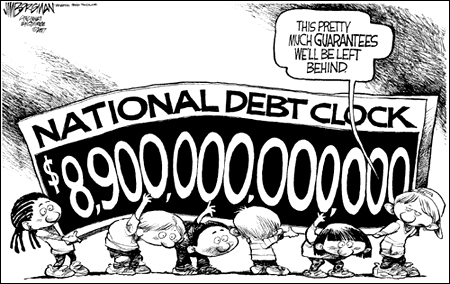
Click here for an illuminating infographic (hat tip – Ronan Gallagher), which helps us understand the scale of the European debt crisis. They also have an infographic on the scale of the US national debt – click here.
National debt clocks are available here.